Insight Articles: Identity Security Risks Series – The Identity Crisis No One Is Talking About
For Business Owners, CIOs & CISOs [5-minute read]
The Identity Crisis No One Is Talking About
For every employee in your organization, there are dozens of non-human accounts, API keys, service accounts, tokens, and certificates and most of them are completely ungoverned.
Your security team knows exactly which employees have access to your most sensitive systems. They can pull up a list. They know who has Domain Administrator privileges, who approved the last firewall change, and who can access payroll.
Now ask them this: How many non-human identities have administrative access to your production systems right now?
Most security teams cannot answer that question. Not because they are careless, but because the problem has grown faster than anyone anticipated. It has expanded quietly, without governance, without oversight, and often without anyone clearly responsible for managing it. This is the identity crisis that rarely leads cybersecurity discussions. Yet it is increasingly becoming one of the most common findings in major breach investigations.
The Explosion You Never Saw Coming
Every time a developer connects two systems, a new machine identity is created.
An API key is generated. A service account is provisioned. A certificate is issued. A token is created for an automation workflow.
These credentials allow software to authenticate to other software. They never take vacations, never forget passwords, and never question requests. They simply do what they were designed to do. The problem is scale.
Machine identities are now being created at a pace that far exceeds human identities. While organizations carefully govern employee accounts, millions of non-human identities are being deployed across cloud platforms, applications, containers, DevOps pipelines, and AI services with little or no centralized visibility.
82-144:1
Machine identities for every human employee – the ratio varies by industry and cloud adoption, and has grown sharply year over year
44%
Year-over-year growth in non-human identities – the fastest-expanding attack surface in enterprise security
80%
Of identity-related breaches now involve non-human identities – service accounts, API keys, tokens, and certificates
18.1 M
API keys and authentication tokens found exposed in public code repositories in 2025 – each one a potential entry point
These credentials accumulate continuously. Developers create them to connect applications. IT administrators provision them to keep infrastructure running. Operations teams generate them to automate processes. They are a byproduct of modern IT.
Unlike employee accounts, machine identities often lack consistent governance. Many are never reviewed, their permissions are never reassessed, and when the applications they support are retired, the identities frequently remain behind with the same access they were originally granted.
Now the problem is accelerating. AI agents are introducing an entirely new generation of machine identities. Every AI assistant, autonomous workflow, integration, and intelligent bot that interacts with business systems requires credentials of its own. As organizations rapidly adopt AI, thousands of new identities are being created by teams focused on innovation, not identity governance.
The result is an expanding attack surface that is growing faster than most security programs can keep up with.
“Attackers don’t need your employees’ passwords anymore. They need one forgotten API key, one abandoned service account, or one overprivileged token. Most organizations have more of those than they realize.”
Why Attackers Love Machine Identities
From an attacker’s perspective, machine identities are the perfect target. They never question an unexpected request. They never notice someone logging in at 3:00 a.m. from another country. They never report suspicious activity. They never change their own passwords.
They simply authenticate. Silently. Automatically. Reliably.
Many remain active for months or even years without anyone verifying whether they are still needed, whether their permissions are appropriate, or whether anyone is monitoring how they are being used. That makes them an ideal foothold for attackers.
Machine identities are often overlooked, infrequently monitored, and granted more privileges than they require. Yet many have persistent access to production systems, cloud environments, databases, and critical business applications.
Unlike a compromised employee account, there is often no human on the other end to recognize that something is wrong.
The Breaches That Define the Problem
The AI Acceleration
Just as organizations are beginning to recognize the machine identity problem, artificial intelligence is making it exponentially larger. Every AI agent, autonomous workflow, and generative AI integration needs to authenticate with other systems. To do that, it is issued machine identities such as API keys, service accounts, tokens, and certificates.
Unlike traditional enterprise applications, many AI solutions are being deployed directly by business units eager to improve productivity. Security reviews often happen later, if they happen at all. The result is an explosion of new machine identities being created outside established identity governance processes.
Many of these identities are granted access to cloud storage, email platforms, financial systems, CRM applications, and customer databases. Once deployed, they often remain in place long after the original project has ended, with permissions that are rarely reviewed and credentials that are seldom rotated. The machine identity challenge was already growing faster than most organizations could manage. AI is accelerating it.
Do You Know Your Blast Radius?
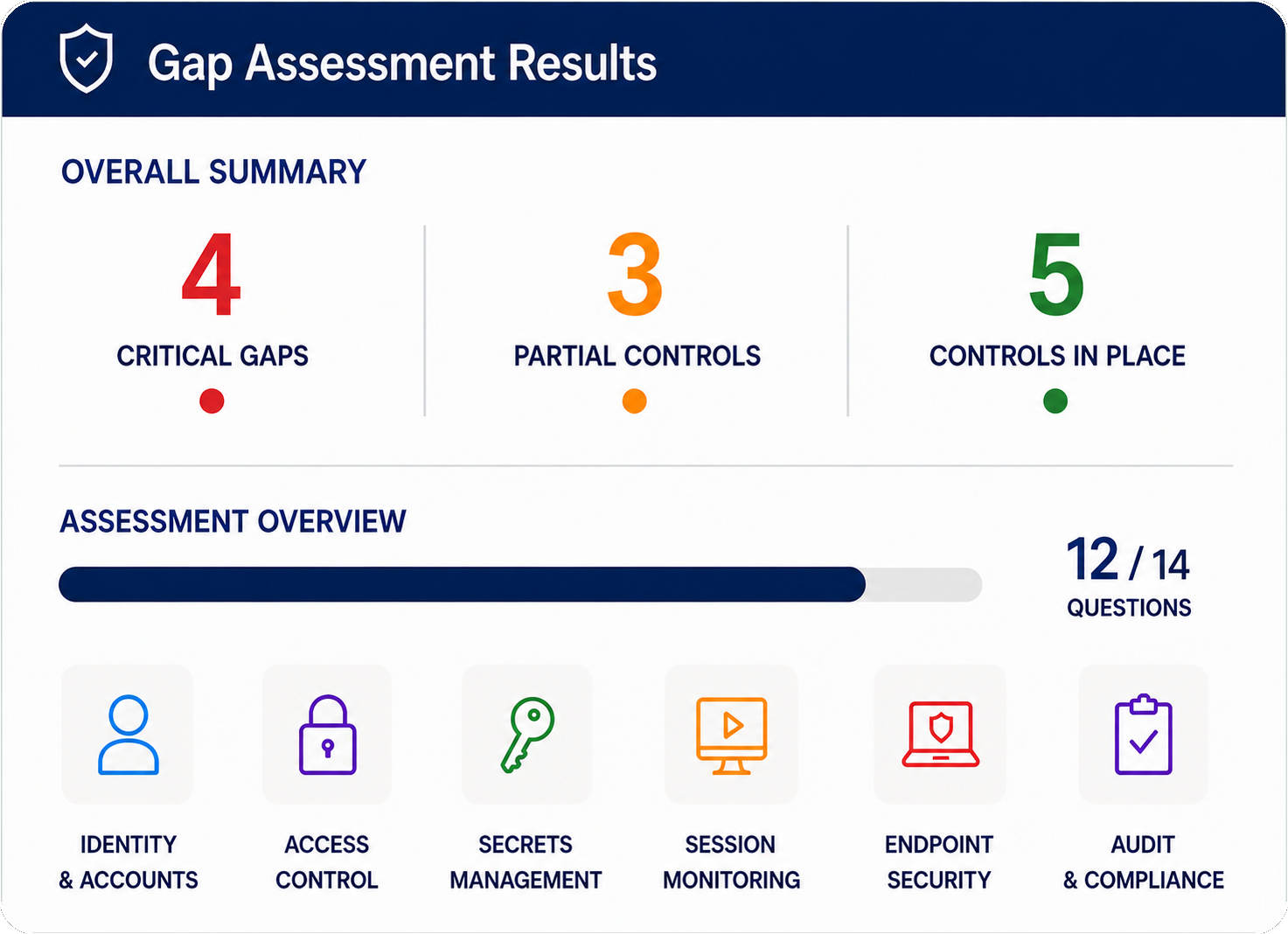
Take our Identity Security Gap Assessment, a structured evaluation that uncovers the hidden machine identities, privileged accounts, and access exposures attackers are most likely to exploit, and shows you where your greatest risks exist.
How Exposed Is
Your Company?
Uncover hidden risks across privileged accounts, credentials, vendor access, MFA, session monitoring, and compliance controls. Take our 5 minute Gap Assessment to see where your biggest security gaps may be hiding.