Why Your Business Needs Privileged Access Management
The Problem
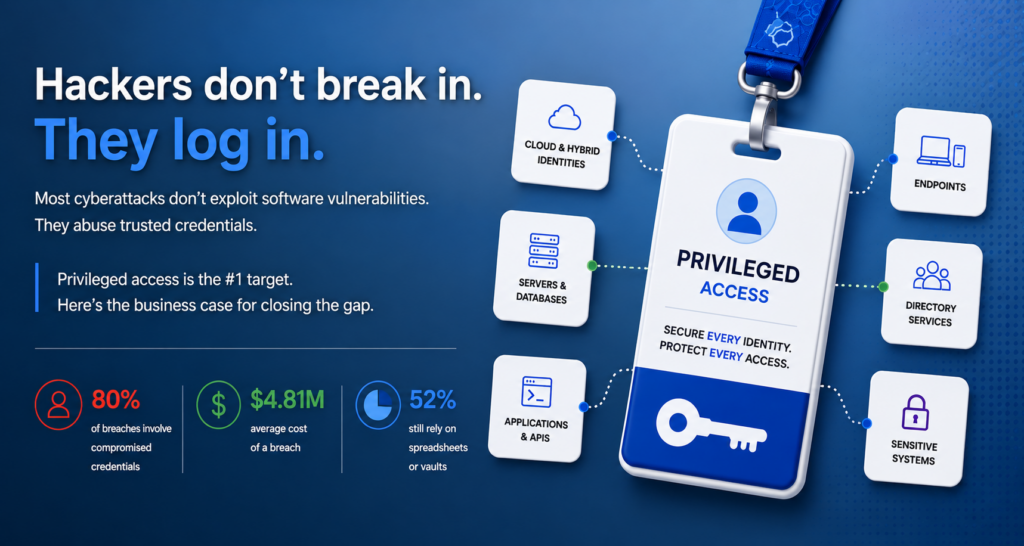
Your most dangerous accounts are probably unprotected
Privileged accounts represent the highest level of access within an organization and are frequently targeted by cybercriminals. Yet many organizations lack the controls needed to effectively secure, monitor, and govern this access. The result is increased exposure to security breaches, compliance violations, insider threats, and operational disruption.
Ask yourself a simple question.
Who logged into your most privileged accounts last Tuesday at 2:00 AM?
For many organizations, the honest answer is: we don’t know.
The uncomfortable truth: If an attacker obtains one set of privileged credentials, they typically have unrestricted access to your entire environment, your data, your systems, your backups, and your customers’ information. And in most organizations, they could remain undetected for weeks or months. IBM found that credential-based breaches take an average of 292 days to identify and contain.
How Attacks Happen
The anatomy of a privileged access attack
Modern cyberattacks follow a predictable path once credentials are in play:
The Solution
How can you solve this?
Privileged Access Management platform built for organizations that need enterprise-grade security without enterprise-grade complexity. Its products work together to discover, secure, monitor, and govern every privileged account across your environment, on-premises, cloud, and hybrid.

Core Vault
Privileged Credentials in a Vault
Centralized credential vault with automated rotation, access controls, and full session recording
The Problem It Solves
Privileged passwords are shared informally, stored in spreadsheets, and rarely changed. When an employee leaves or a contractor completes a project, old credentials remain active — giving anyone who has them continued access. If a breach occurs, there is no record of who accessed what or when.
Key Capabilities
- Encrypted vault AES-256 encrypted storage for all privileged credentials, no more spreadsheets or sticky notes
- Auto password rotation Credentials rotate automatically on a schedule or after each use, eliminating stale access
- Session recording Every RDP and SSH session is recorded and logged — full forensic trail for audits or incidents
- 150+ templates Pre-built connectors for Windows, Linux, databases, network devices, cloud platforms, and more
- Checkout controls Users check out credentials for specific tasks; access is time-limited and fully logged
Endpoint Control
Manage End Point Privileges
Remove local admin rights from workstations and enforce least privilege at the endpoint
The Problem It Solves
Most employees — and attackers who compromise their machines — run with local administrator rights. Malware executed on a local admin machine inherits those same privileges, enabling it to install software, disable antivirus, and spread laterally to other systems on the network. Ransomware attacks almost universally exploit this.
Key Capabilities
- Admin rights removal Removes standing local admin rights from all endpoints without disrupting user workflows
- Just-in-time elevation Specific approved applications are elevated on demand, no IT ticket, no permanent backdoor
- Application control Allow or block specific applications by policy, preventing unauthorized software installation
- Windows & macOS Unified policy management across both operating systems from a single console
- Ransomware prevention Blocks lateral movement by ensuring malware cannot escalate to admin privileges automatically

DevOps & Automation
Remove Hardcoded Passwords
Eliminate hardcoded credentials in code and CI/CD pipelines with dynamic secrets injection
The Problem It Solves
Developers routinely embed database passwords, API keys, and service credentials directly in application code, configuration files, and CI/CD scripts. These hardcoded secrets are committed to source control repositories, shared across environments, and almost never rotated — creating a hidden attack surface that most security teams don’t know exists.
Key Capabilities
- Dynamic injection Applications request credentials at runtime via API and receive time-limited tokens, no secrets in code
- Pipeline integrations Native integrations for Jenkins, Kubernetes, Terraform, Ansible, and Azure DevOps
- BYOK encryption Bring-your-own-key support means your encryption keys never leave your control
- CLI & REST API Developer-native interface that fits existing workflows without slowing delivery velocity
- Vault sync Syncs with Secret Server so all secrets, human and machine, are governed from one platform

Server Access
Secure Privileged Cloud Access
Just-in-time, time-limited access to Linux, Unix, and cloud servers without sharing persistent credentials
The Problem It Solves
Production servers typically have a small set of shared SSH or RDP credentials that administrators, contractors, and vendors all use. There is no way to know which individual was responsible for a specific action, credentials accumulate with people who no longer need them, and third-party vendors carry the same level of access as your own team with no time limit or scope restriction.
Key Capabilities
- Just-in-time access Elevated server access is issued for a specific task and revoked automatically when the task is complete
- No standing sessions Eliminates permanently open admin sessions that are prime targets for lateral movement attacks
- Auto privilege removal Privileges and credentials rotate immediately after each session, no residual access lingers
- Vendor & contractor access Third parties receive tightly scoped, time-bound access without ever holding a persistent credential
- Cloud compatible Works natively across AWS, Azure, and GCP environments as well as on-premises infrastructure
Compliance
PAM is no longer optional for regulated industries
Cyber insurance providers, auditors, and regulators increasingly require demonstrable privileged access controls as a baseline condition. Built-in audit reporting maps directly to the requirements of the major frameworks:
“Organizations increasingly approach us with more stringent cyber insurance requirements, often necessitating more modern Privileged Access Management controls.”
Phil Calvin, Chief Product Officer, Delinea
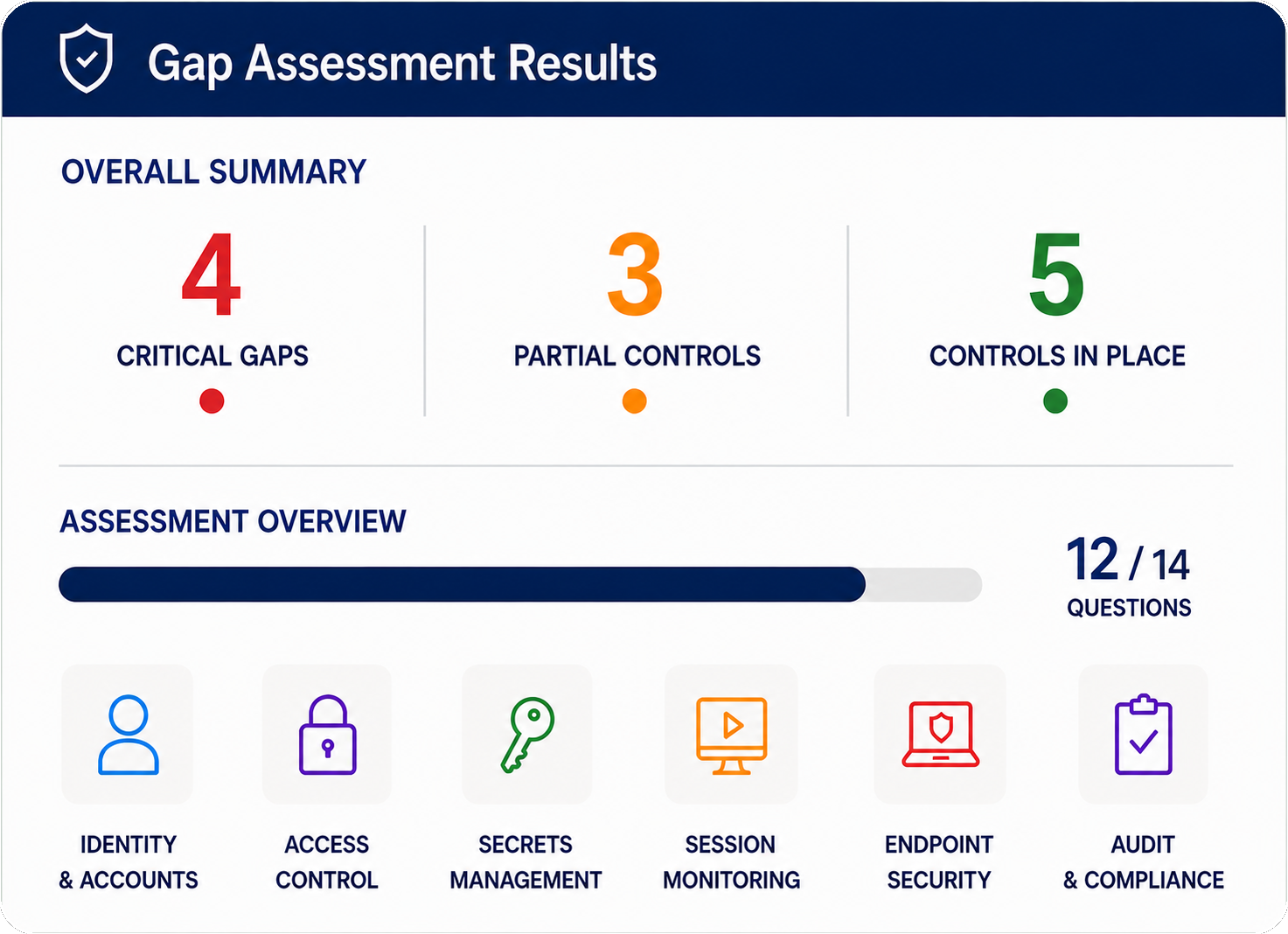
How Exposed Is
Your Company?
Uncover hidden risks across privileged accounts, credentials, vendor access, MFA, session monitoring, and compliance controls. Take our 5 minute Gap Assessment to see where your biggest security gaps may be hiding.