Insight Articles: Identity Security Risks Series – Ungoverned Machine Credentials
For Business Owners, CIOs & CISOs [8-minute read]
Ungoverned Machine Credentials
Forgotten API keys. Over-privileged service accounts. Integration tokens that outlived the projects that created them. These machine credentials fuel many of today’s biggest identity breaches, and most organizations have thousands they can’t account for.
Somewhere in your organization right now, an API key with administrator access to a production database probably exists. It was created by a developer two years ago for a project that has long since ended. The developer has left the company. The key was never rotated, never deprovisioned, and never added to any inventory. It still sits in a configuration file, a code repository, or a shared document, waiting for someone to find it.
This is not a hypothetical scenario. It is one of the most common patterns behind enterprise machine identity breaches. The credentials that lead to compromise are rarely the ones governed by formal security controls. They are the credentials created to solve a business problem, then forgotten when that problem was solved.
Before We Go Further
What Is a Machine Identity?
A machine identity is a credential that allows software to authenticate to other systems without human involvement. Common examples include API keys, service accounts, certificates, and OAuth tokens.
Unlike human accounts, machine identities are often created, forgotten, and left active long after the people or projects that created them are gone.
The Credentials That Actually Cause Breaches
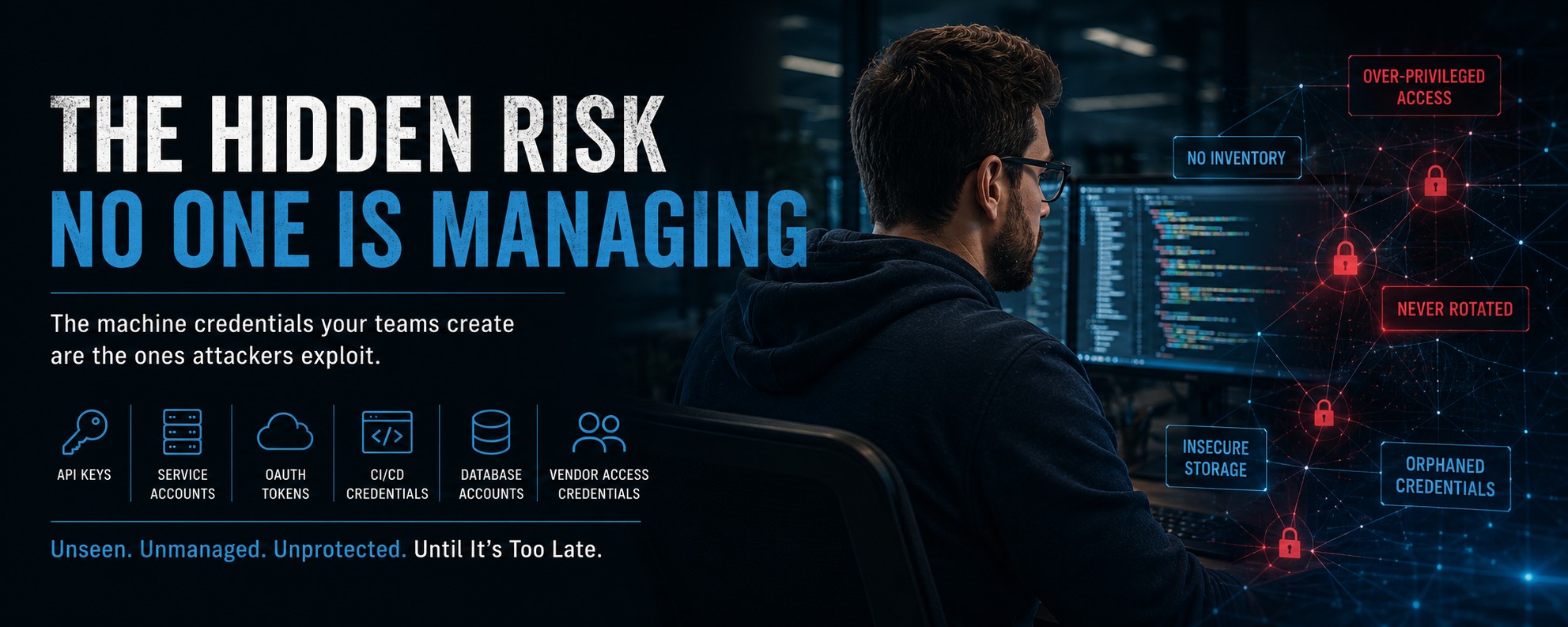
The machine credentials that repeatedly appear in breach investigations share a common pattern. They were created by developers, IT administrators, or operations teams to solve an immediate business need, but without formal governance, security review, or a lifecycle management plan. Over time, they accumulate permissions, outlive the systems that created them, and remain active in places that are far more accessible than anyone realizes.
The Machine Credentials Behind Many Identity Breaches
- Developer-created API keys: Created for a project, then never rotated or revoked
- OAuth integration tokens: Connecting SaaS applications with broad permissions that are rarely reviewed
- Legacy application service accounts: Still active long after the application was retired
- CI/CD pipeline credentials: Retaining production deployment rights long after they are needed
- Database service accounts: Granted excessive privileges to avoid the effort of implementing least privilege
- Third-party vendor credentials: Never revoked after projects or support engagements end
What This Looks Like Inside a Real Organization
The machine identity problem becomes much easier to understand when you follow a single developer through an ordinary year of work, then look at what remains after they leave. One Developer. One Year. Lasting Risk.

Created During His Time at the Company
- AWS access keys for development, staging, and production, manually created, embedded in configuration files, never rotated.
- API keys for Stripe, SendGrid, and Twilio, stored in a shared document and rotated only when someone remembers.
- GitHub Actions deployment token with production administrator rights, granted “temporarily” and never reduced.
- Database service accounts for three applications, all assigned administrator privileges because least-privilege permissions would take longer to configure.
- OAuth token connecting the analytics platform to the data warehouse with broad, permanent read access.
- TLS certificates for four services, two of which expired before anyone noticed.
Still Active After Marcus Leaves
- Service accounts supporting applications retired 18 months earlier, still enabled with production access.
- AWS keys, API keys, and database credentials he created, all still valid even though his Active Directory account was deprovisioned.
- GitHub Actions deployment token, still capable of deploying code directly into production because no one realized it needed to be revoked.
Marcus is just one developer. Now multiply him by every developer, IT administrator, DevOps engineer, cloud architect, and contractor who has worked in your organization over the past five years. The machine credential inventory no one is actively managing is almost certainly far larger than anyone believes.
“The attackers aren’t looking for your backup agent’s certificate. They’re looking for the API key Marcus left in a GitHub repository, the one with admin access to your production environment.”
The Characteristics That Make a Machine Credential Dangerous
A machine credential becomes a serious security risk when it combines several characteristics that are remarkably common in enterprise environments.
1. Excessive Privilege
Service accounts and API keys are often granted administrator or database-level privileges because it is faster than defining precise permissions. A credential with excessive privileges becomes a master key to your environment. If an attacker finds it, there is no need to escalate privileges because they already have them.
2. No Rotation
Unlike human passwords, machine credentials are frequently configured to never expire because rotating them can disrupt applications and integrations. The result is a credential that remains valid indefinitely, including for anyone who steals it.
3. No Inventory
Most organizations cannot produce a complete inventory of their machine credentials: who created them, what they can access, when they were last used, or whether they are still required. You cannot secure what you cannot see.
4. Insecure Storage
API keys and other machine credentials are commonly stored in source code repositories, configuration files, shared documents, and environment variables. These locations are often accessible to far more people than intended and continue to exist long after the credentials should have been retired.
5. Orphaned Credentials
Projects end. Applications are retired. Teams move on. The machine credentials created to support them often remain active. These orphaned credentials retain access to live systems despite having no owner, no business purpose, and no one monitoring their use.
The Breaches That Prove the Point
The Governance Questions That Reveal the Gap
The true measure of machine identity security is not how many credentials your organization has. It is how many you can identify, manage, and account for. The API keys your developers created, the service accounts supporting legacy applications, and the integration credentials connecting your business systems are the identities that require governance throughout their entire lifecycle.
The Questions Every Organization Should Be Able to Answer
- Can you produce a complete inventory of every API key, service account, and OAuth integration?
- Which credentials have administrator or other privileged access?
- When was each credential last rotated?
- Who is the current owner?
- Which credentials are no longer needed but remain active?
If you cannot confidently answer these questions, you do not have governance over your machine identities. Neither will the attacker who discovers them. The difference is that the attacker only needs to find one.
80%
Of identity-related breaches involve non-human identities – specifically the unmanaged, human created kind
18.1 M
API keys and authentication tokens found exposed in public code repositories in 2025 – put there by developers, not vendors
44%
Year -over-year growth in non-human identities- driven by cloud adoption, microservices, and AI automation tools
50%
Of organizations report a breach linked to machine identity compromise – with API keys and service accounts as the primary vectors
For most enterprises, the number of ungoverned machine credentials runs into the thousands. Within that inventory are API keys, service accounts, and integration credentials with administrator access to production systems, many created by people who no longer work for the organization and stored in locations that have never been audited.
Those are the credentials attackers are looking for. The only question is whether you’ll find them first.
Do You Know Your Blast Radius?
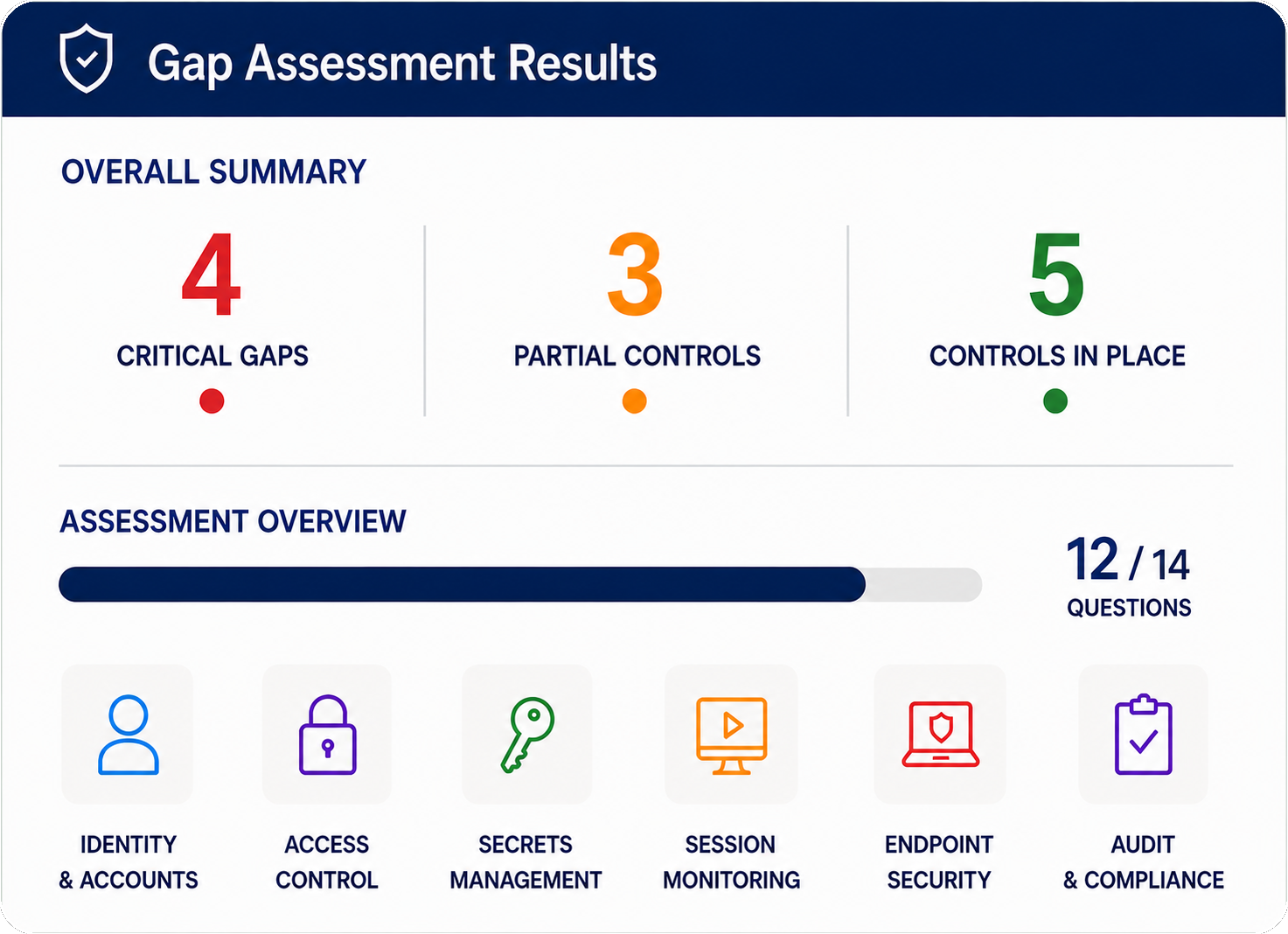
Take our Identity Security Gap Assessment, a structured evaluation that uncovers the hidden machine identities, privileged accounts, and access exposures attackers are most likely to exploit, and shows you where your greatest risks exist.
How Exposed Is
Your Company?
Uncover hidden risks across privileged accounts, credentials, vendor access, MFA, session monitoring, and compliance controls. Take our 5 minute Gap Assessment to see where your biggest security gaps may be hiding.