Insights Article: The Ransomware and Data Breach Series – Denied Cyber Insurance Claims

For Business Owners, CIOs & CISOs [5-minute read]
Denied Cyber Insurance Claims
Your Cyber Insurance Won’t Save You. Here’s What Will.
“More than 40% of cyber insurance claims filed in 2025 were denied. The organizations that got nothing had one thing in common: they believed their policy meant they were covered. It did not.“
You have cyber insurance. You pay the premium every year. When the breach comes, and based on current statistics it is a matter of when, not if, you have a plan: call the insurer, file the claim, and let the policy absorb the damage
That plan has a fatal flaw.
Cyber insurance is not a guarantee of payment. It is a contract with conditions, attestations, exclusions, and fine print that most organizations never read carefully until they need it most and discover, too late, that the coverage they were counting on does not apply.
The insurance industry paid out billions in ransomware and data breach claims between 2020 and 2023. It did not do so quietly. It rebuilt its underwriting model from the ground up. What was once a simple questionnaire has become something much closer to a technical audit. What was once a reliable safety net has become, for a growing number of organizations, an expensive illusion.
More than 40% of cyber insurance claims were denied in 2024. Claims rose 40% Payouts did not keep pace.
Nearly 50,000 cyber claims were filled in 2024. Tens of thousand were rejected, not because the attacks weren’t real, but because the organizations did not meet the conditions of their own policies. Take a free risk assessment to uncover data breach vulnerabilities before attackers do.
The Questionnaire Is Not a Formality… It Is a Legal Document
Every cyber insurance application includes a questionnaire. It asks about your security controls: whether you use multi-factor authentication, how you manage privileged accounts, whether you have endpoint detection tools, how you handle backups, and dozens of other technical details. Most organizations treat it as an administrative exercise, a box-ticking task completed by whoever is available, returned quickly, and filed away. That is a catastrophic mistake!
What you attest to on that questionnaire is your legal representation to the insurer about the state of your security at the time of application. If you experience a breach and a forensic investigation reveals that your actual controls did not match what you described, even if the discrepancy seems minor or resulted from an oversight rather than deliberate misrepresentation, your insurer may have grounds to rescind the policy entirely and deny every dollar of your claim.
“The questionnaire does not ask about your intentions. It asks about your actual controls. And now, insurers verify the answers independently before they ever issue a policy.“
Three out of four carriers now run external attack surface scans during the underwriting process. Before they quote your premium, they already know whether your remote access portals are exposed, whether your email systems have proper authentication records configured, and whether your endpoints show signs of active security tooling. The questionnaire you submit is cross-checked against what they can observe from outside your network. The gap between the two is the gap that voids your coverage.
What Underwriters Are Actually Looking For
The controls that underwriters weight most heavily have shifted significantly in recent years. They are no longer satisfied with a firewall and an antivirus subscription. The specific controls that now determine your premium, and your eligibility for coverage at all, map directly to the attack vectors responsible for the largest claims.
What underwriters actually check — and what they verify independently
-
Multi-factor authentication on privileged accounts
Not just email login. MFA on every administrative, cloud, and remote access account. SMS-based MFA is increasingly rejected; carriers now require phishing-resistant MFA (authenticator apps, hardware keys) for admin-level access.
-
Privileged access management and governance
Do you know every account with elevated access? Are service accounts, cloud administrators, and delegated privileges centrally monitored? Undiscovered or unmonitored privileged accounts are treated as uncontrolled risk.
-
Endpoint detection and response (EDR) on every device
Carriers run external scans to detect deployed EDR agents. “Most endpoints” is not sufficient, gaps are visible and penalized.
-
Tested, immutable backups
Backups that exist but have never been tested for restoration are not considered a meaningful control. Underwriters now ask for evidence of tested restores, not just the existence of a backup system.
-
A documented, tested incident response plan
A written plan that has never been exercised carries little underwriting weight. Many carriers now ask for evidence of a recent tabletop exercise before quoting.
Failing these controls does not just affect whether you can file a claim later. It affects whether you can get coverage at all. Organizations that fail technical assessments are seeing premium increases of 40 to 100%, coverage exclusions for the very attacks they are most likely to face, or outright policy denials that force them into surplus lines markets where premiums can be three times higher.
Documented, verifiable controls, on the other hand, can reduce renewal premiums by 20 to 40%. On a $20,000 policy, that represents $5,000 to $8,000 in annual savings simply by proving your security posture matches what you claimed.
When the Claim Comes — and Is Denied
The Questionnaire Is Your Risk Map If You Use It That Way
Here is what the cyber insurance industry has understood for years that most organizations have not: the questionnaire is not just paperwork. It is a roadmap to the security gaps most likely to result in a catastrophic loss. Every question represents a control that, when missing, has contributed to major claims. Insurers did not invent these questions. They built them from loss data, forensic investigations, and the lessons learned from thousands of ransomware attacks and data breaches.
When an underwriter asks whether you have multi-factor authentication on all privileged accounts, it is because the absence of MFA on a privileged account has been the documented entry point for many of the costliest attacks on record. When they ask about privileged access governance, it is because unmonitored accounts with elevated privileges are often how attackers turn a single compromised credential into complete control of an organization’s network.
The controls the insurer requires are the same controls that prevent the attack in the first place. Closing the gap is not just a coverage question, it is your primary defense against the incident you’re insuring against.
The organizations that navigate this landscape successfully are those that treat the questionnaire as a security assessment, not a sales process. They know exactly which controls they have, where the gaps are, and what it would take to close them. That knowledge determines their premium, their coverage, and most critically, whether the policy they pay for will actually perform when the moment comes.
The question is not whether you have cyber insurance. It is whether you can prove, with evidence, that the controls you attested to are genuinely in place today, not when you last filled out the form.
Do You Know Your Blast Radius?
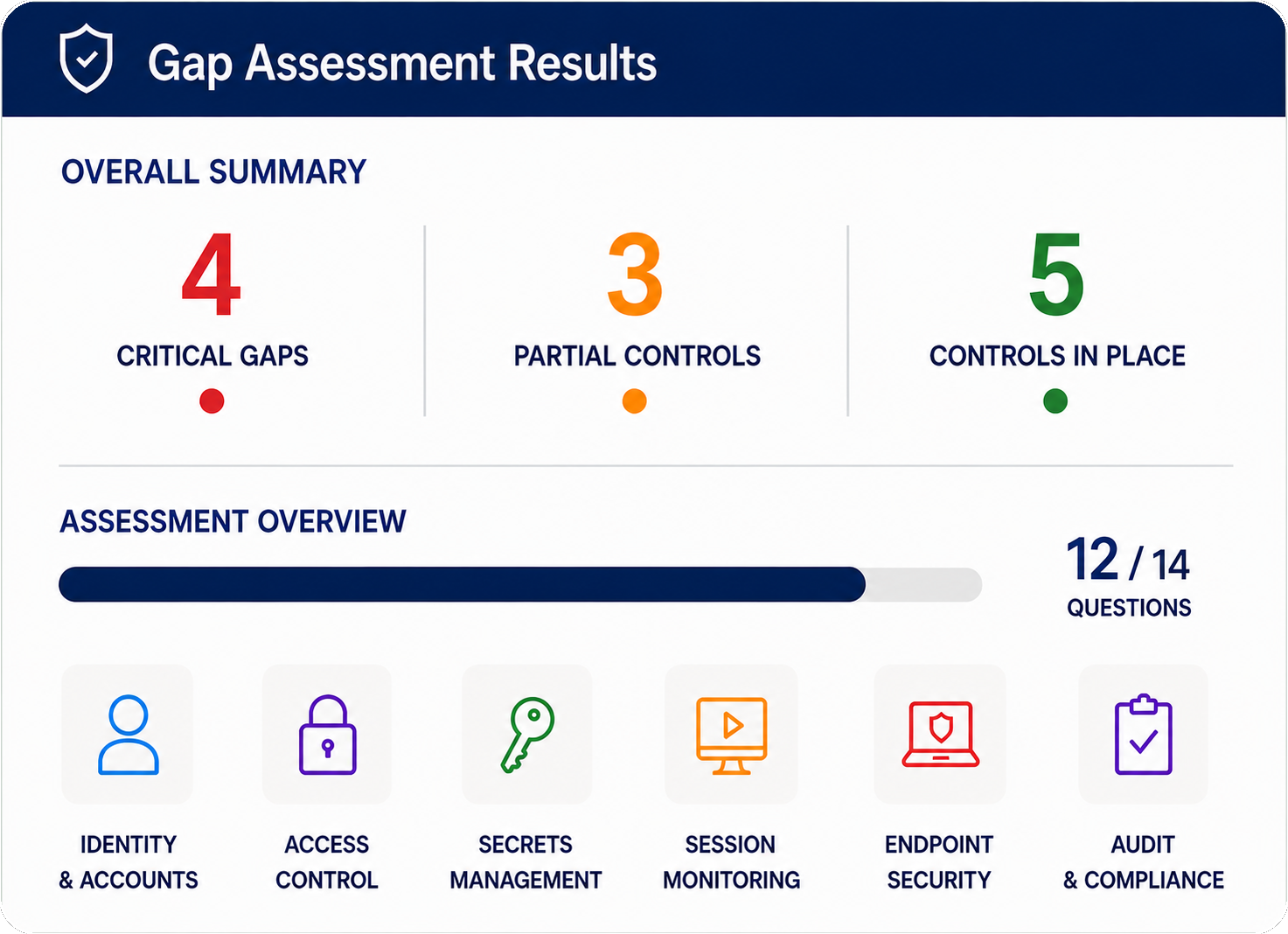
If you cannot answer the questionnaire with confidence, you cannot file the claim with confidence. Our Ransomware & Data Breach Gap Analysis maps your privileged access controls against exactly what cyber insurance underwriters require so you know where your gaps are, what they cost you in premiums, and what it would take to close them.
How Exposed Is
Your Company?
Uncover hidden risks across privileged accounts, credentials, vendor access, MFA, session monitoring, and compliance controls. Take our 5 minute Gap Assessment to see where your biggest security gaps may be hiding.