Insights Article: Municipal Cybersecurity Series – Identity Security

For CAOs, CIOs & IT Directors & Municipal Leaders [8-minute read]
Municipal Cyberattacks Rarely Begin with Ransomware
Somewhere in Canada today, a municipal network is being quietly explored by an attacker.
They’re not deploying ransomware. Not yet. Instead, they’re taking inventory:
- Mapping systems and infrastructure
- Identifying privileged accounts
- Locating backups
- Testing security controls
- Waiting for the moment that will cause the greatest disruption
The City of Hamilton didn’t know. The City of Whistler didn’t know. Most municipalities don’t. By the time ransomware is deployed, the attacker has often spent weeks or months inside the environment, learning how your municipality operates and ensuring the attack will have maximum impact.
The question isn’t whether attackers are targeting municipalities. The question is whether your organization would know before everything stops working.
Imagine Monday Morning at City Hall
It’s 8:30 a.m. and employees are arriving. Coffee cups are still full. Then the first calls start coming in.
- The permitting system won’t load
- Payroll is unavailable
- Property tax is offline
- Council email has stopped working
- 311 can’t accept requests
- Parks and recreation staff can’t access bookings
- Water operations have lost connectivity to critical systems
- Fire dispatch has switched to manual procedures
- Within minutes, your phone rings
- First the Director of IT
- Then the CAO
- Then the Mayor
- And shortly after that, the local media
Every question is the same. What happened? How long will we be down?
This isn’t a hypothetical scenario. It’s exactly what the City of Hamilton experienced in February 2024. It’s what happened to the Municipality of Whistler in April 2021. And it’s a reminder that municipal cyberattacks rarely begin the day systems go offline.
By the time ransomware is deployed, attackers have often spent weeks or months inside the network, identifying privileged accounts, mapping critical systems, locating backups, and waiting for the moment when disruption will have the greatest impact.
“The difference between those municipalities and the next one isn’t who gets targeted. It’s who discovers the attacker first, before Monday morning becomes a headline.”
Two Municipalities. Two Different Attack Paths. One Common Lesson.
Hamilton and Whistler were compromised in very different ways. That’s what makes these incidents so important. There isn’t a single vulnerability to eliminate or one product that prevents ransomware. Municipal resilience comes from building a security posture that assumes attackers will continuously look for new ways in.
City of Hamilton (2024): Weak Credentials and No MFA
Attackers gained access through an internet-facing server protected by weak credentials and no multi-factor authentication. A phishing email helped establish the initial foothold.
Once inside, they didn’t launch ransomware immediately.
For more than a week, they quietly explored Hamilton’s network, mapping systems, identifying privileged accounts, locating backups, and learning how the city operated. Only after they understood the environment did they deploy ransomware.
The result was devastating. Approximately 80% of Hamilton’s network was taken offline, and several critical systems were ultimately deemed unrecoverable.
Resort Municipality of Whistler (2021): An Unpatched VPN
Whistler’s attackers didn’t rely on stolen credentials. Instead, they exploited a publicly known vulnerability in the municipality’s SonicWall VPN appliance, one for which a security patch had already been released. The HelloKitty ransomware group was actively scanning the internet for organizations that had not applied the update. Whistler appeared on that list.
Staff arrived one morning to discover systems had rebooted around 4:00 a.m. The primary backup appliance had been erased. The attackers had already identified and destroyed the municipality’s primary recovery path before launching the attack. Fortunately, a secondary backup survived, allowing the municipality to recover over the following months.
The attackers also claimed to have exfiltrated approximately 800 GB of data, including resident information, email archives, passwords, and internal network documentation.
Unlike Hamilton, a significant portion of Whistler’s recovery costs was covered by cyber insurance because the municipality had implemented the security controls required under its policy.
Different Entry Points. The Same Outcome.
One municipality was compromised through weak identity controls. The other through an unpatched internet-facing system. Different techniques. Same objective. Gain trusted access, move through the network unnoticed, identify privileged accounts and backups, then strike when recovery is most difficult. That’s the lesson every municipality should take away.
The question isn’t how attackers get in. It’s whether your organization can detect them before they reach your most critical systems.
“The Canadian Centre for Cyber Security (CCCS) is blunt: municipalities are among the most frequently targeted organizations in Canada. This isn’t random. It’s strategic.”
Why attackers specifically come for municipalities:
- You provide essential services. Residents cannot go without water, fire dispatch, or payroll. That pressure to restore services quickly makes you more likely to pay.
- Your IT budget is constrained by public accountability. Security investment competes with roads, parks, and services. Attackers know this.
- Legacy systems carry known vulnerabilities. The SonicWall flaw that brought down Whistler was publicly documented. Attackers run automated scans for exactly these signatures.
- Most ransomware actors are opportunistic. They are not targeting your city by name. They are scanning the internet for weak credentials and unpatched systems — and taking whoever answers.
- “We’re too small to be a target” is a myth the CCCS explicitly debunks. Automated scanning makes size completely irrelevant.
Disrupt enough essential services, and the pressure to restore operations quickly becomes immense. Every hour of downtime affects residents, businesses, and public safety. Attackers understand this, which is why municipalities have become some of the most attractive ransomware targets in Canada.
Anatomy of a Municipal Ransomware Attack
| Stage | What the Attacker Is Doing | What Your Municipality Sees |
|---|---|---|
| Day 1 | Gains initial access through phishing, weak credentials, or an unpatched system. | Nothing unusual. Business as usual. |
| Days 2–7 | Maps the network, identifies privileged accounts, explores critical systems, and locates backups. | No visible disruption. Normal operations continue. |
| Days 7–14 | Escalates privileges, moves laterally, disables security controls, and targets backup infrastructure. | Minor anomalies, if any, that are easily overlooked. |
| Attack Day | Deploys ransomware across the environment and disrupts essential municipal services. | Systems fail. Staff cannot work. Council, the CAO, residents, and the media demand answers. |
| Weeks to Months | Recovery, forensic investigations, rebuilding infrastructure, restoring services, insurance claims, audits, and public communications. | Millions of dollars in recovery costs and a long road back to normal operations. |
The ransomware attack isn’t the beginning of the incident. It’s the moment your municipality finally discovers it.
When residents can’t pay property taxes, obtain permits, renew business licenses, or trust that their municipality can protect their personal information, the impact extends well beyond IT. It becomes a public confidence issue.
AI Has Changed the Rules
The attacks that crippled Hamilton and Whistler were devastating.
The next generation of attacks will be even harder to stop. AI has dramatically lowered the cost, speed, and sophistication of cybercrime. Capabilities that once required skilled human operators are now available to virtually anyone.
AI never gets tired. It never stops scanning for the next vulnerable organization.
Today, AI can:
- Write phishing emails that are virtually indistinguishable from legitimate communications, using flawless grammar and publicly available information.
- Create convincing voice and video impersonations of executives, IT staff, and trusted vendors.
- Scan thousands of internet-facing systems simultaneously, identifying exposed services, weak configurations, and known vulnerabilities in minutes.
- Automate reconnaissance by identifying privileged accounts and opportunities to move laterally once initial access is gained.
The phishing email that gave Hamilton’s attackers their initial foothold was created by a human. The next one may not be.
Today’s AI-generated attacks are highly personalized and often impossible to distinguish from legitimate communications. Relying on employees to recognize every malicious email is no longer a realistic security strategy.
That is why the controls before the human layer have become essential.
- Multi-factor authentication
- Privileged Access Management
- Identity governance
- Network segmentation
- Immutable offline backups
These controls assume someone will eventually click. They prevent that click from becoming a municipal crisis.
The Budget Every Council Eventually Faces
Every municipal IT leader will eventually stand before Council to justify one of two budgets:
- The budget for prevention or,
- the budget for recovery
Hamilton learned that the second is far more expensive. When ransomware struck the City of Hamilton, the initial recovery estimate was $9.6 million. It didn’t stay there. By June 2025, the cost had grown to $18.3 million, almost exactly what the attackers had demanded as ransom.
The city didn’t pay the criminals. Instead, it paid for recovery. Approximately $14 million went to external cybersecurity firms brought in to perform incident response, forensic investigations, infrastructure rebuilding, system recovery, and long-term security improvements.
Those investments were necessary. They also illustrate a difficult reality: security controls that cost thousands or hundreds of thousands of dollars before an attack can become multi-million-dollar emergency projects afterward.
Then came another blow. Hamilton’s cyber insurance claim was denied because multi-factor authentication had not been fully implemented at the time of the breach. The result was that taxpayers, not the insurer, absorbed the full $18.3 million cost.
For municipal leaders, that’s the real budget decision. Invest before the incident… Or explain the recovery costs after it.
The Financial Reality Every Council Should Understand
Hamilton’s recovery costs grew from an initial estimate of $9.6 million to $18.3 million because the city wasn’t simply restoring systems. It was rebuilding trust, infrastructure, security controls, and operational resilience after the attack.
Whistler faced a different outcome. Although recovery still took months, cyber insurance covered a significant portion of the costs because the municipality had implemented the controls required by its policy.
The lesson for every municipality is clear. The cost of implementing foundational security controls is measured in annual operating budgets. The cost of recovering without them is measured in millions of dollars.
Prevention vs. Recovery
- Multi-Factor Authentication (MFA): Hamilton’s cyber insurance claim was denied because MFA had not been fully implemented. A foundational control became an $18.3 million financial issue.
- Privileged Access Management (PAM): Attackers don’t stop after gaining access. They look for privileged accounts that allow them to move across the network. PAM limits what attackers can reach, even if an account is compromised.
- Patch & Vulnerability Management: Whistler’s attackers exploited a known vulnerability for which a security update already existed. A disciplined patch management program removes entire classes of attack before they can be exploited.
- Offline, Tested Backups: Modern ransomware attacks target backup systems before encrypting production data. Offline, immutable, and regularly tested backups can turn a catastrophic event into a recoverable one.
- Cyber Insurance Readiness: Insurance should validate your security posture, not replace it. Confirm that your implemented controls align with your policy requirements before an incident, not during the claims process.
The Budget Decision
Every Council eventually decides where to spend its cybersecurity dollars. Invest in controls before an attack… Or invest in consultants, emergency procurement, legal services, public communications, forensic investigations, and system reconstruction after one. Hamilton and Whistler have already shown Canadian municipalities what both paths look like.
Hamilton lost $18.3 million. Whistler spent months recovering. Neither municipality expected to become a national cybersecurity case study. Neither will the next one. The question is no longer whether municipalities are being targeted. They are. The Canadian Centre for Cyber Security has made that clear. Hamilton and Whistler have demonstrated the consequences. And AI is making it easier, faster, and less expensive for attackers to find their next victim.
If an attacker gained access to your network today, how quickly would you know?
Would they encounter strong identity controls, privileged access restrictions, segmented networks, and immutable backups? Or would they spend days or weeks quietly identifying your most critical systems before anyone realized they were there?
The difference between those two outcomes isn’t luck. It’s preparation. Preparation isn’t measured by whether you’ve purchased cybersecurity tools. It’s measured by whether an attacker can reach your most privileged accounts before you know they’re there.
The municipalities that recover fastest aren’t the ones that hope they won’t be attacked. They’re the ones that assume they will be. Before the next Monday morning at City Hall.
Do You Know Your Blast Radius?
Our Ransomware & Data Breach Gap Analysis identifies the privileged access exposures most likely to result in a breach, and quantifies the risk your organization is carrying right now. Most organizations are surprised by what they find.
How Exposed Is
Your Company?
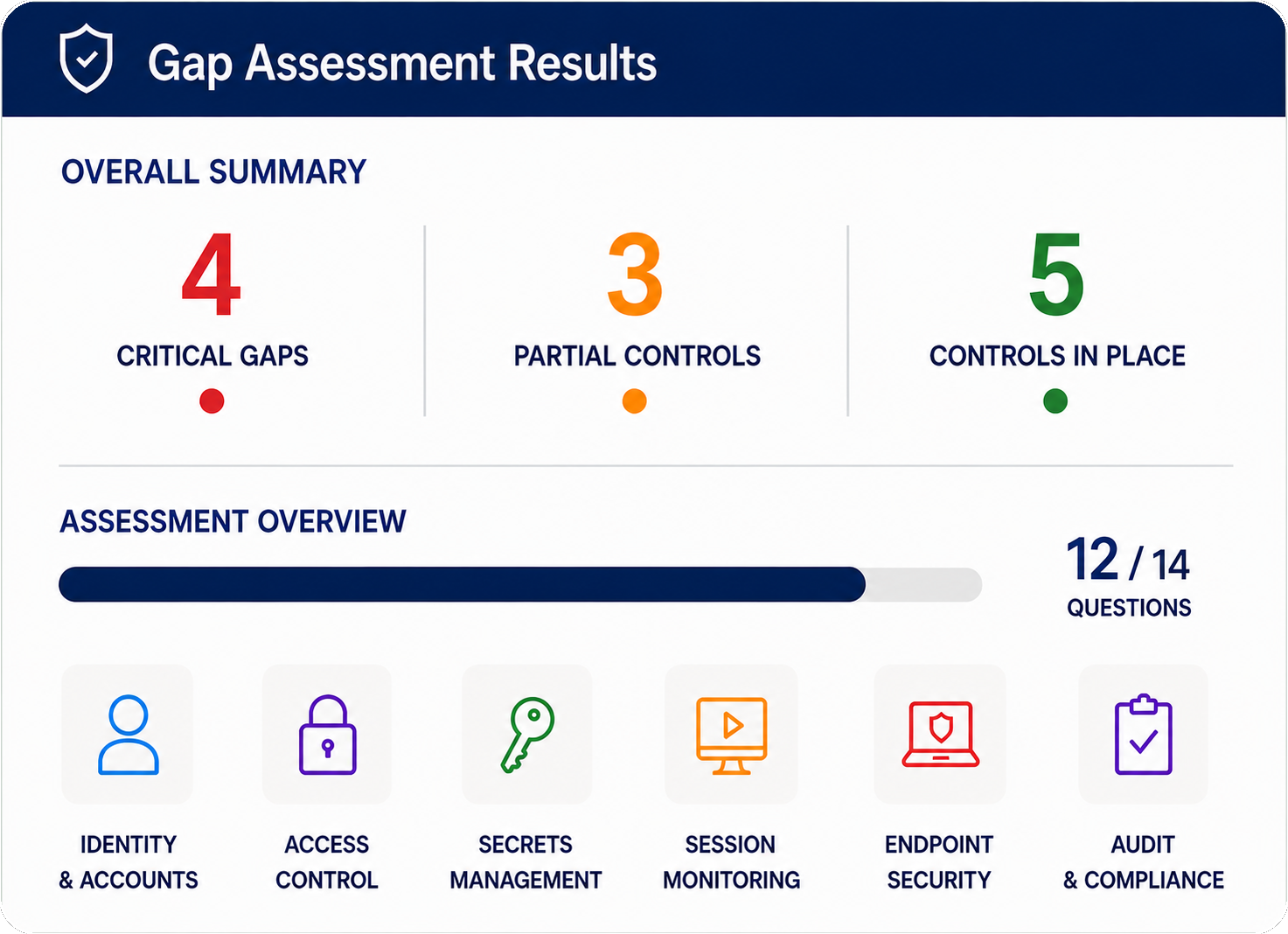
Uncover hidden risks across privileged accounts, credentials, vendor access, MFA, session monitoring, and compliance controls. Take our 5 minute Gap Assessment to see where your biggest security gaps may be hiding.