Insights Article: The Identity Risk Series – Ransomware & Data Breach Nightmares
For Business Owners, CIOs & CISOs [5-minute read]
Ransomware & Data Breach Nightmares
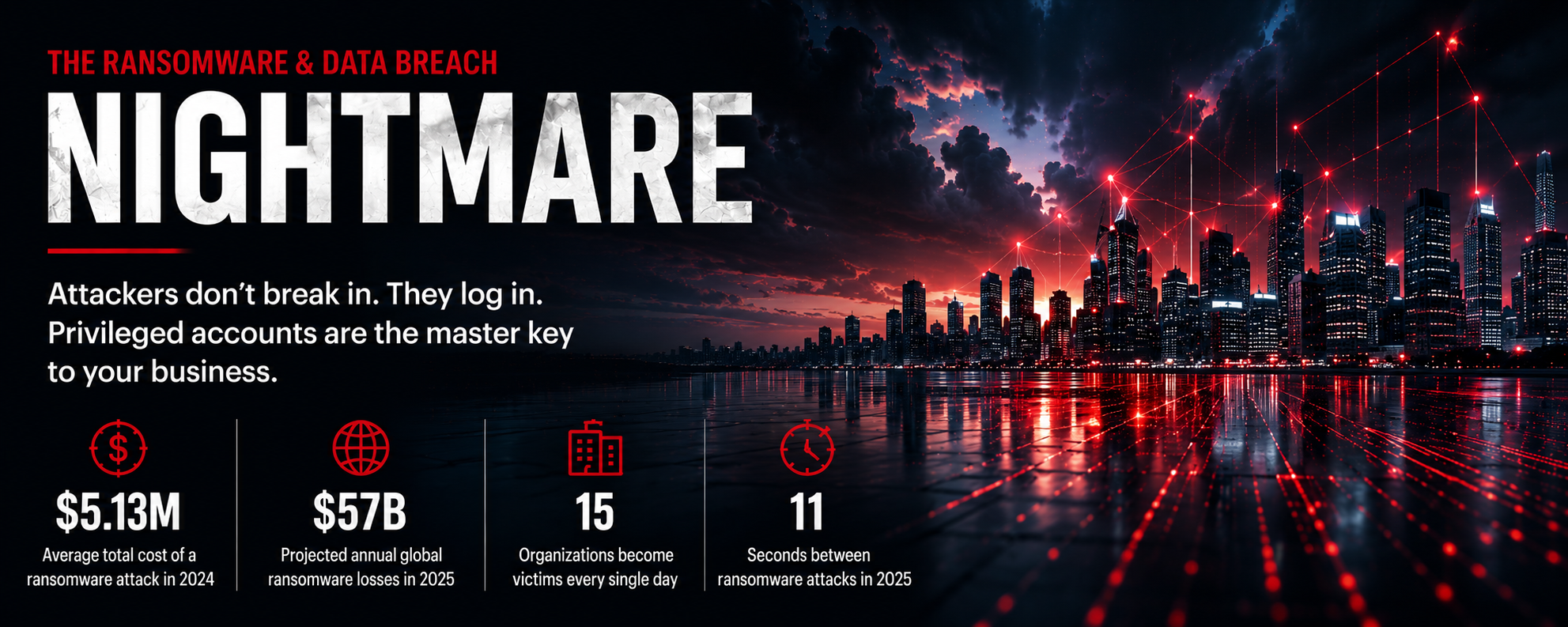
Attackers Don’t Break In… They Log In
“Attackers do not need to breach your perimeter, defeat your firewall, or outsmart your security team. They need one account. One password. Ten minutes. What happens next will define your organization for years.”
It was a ten-minute phone call. The attacker did not need a sophisticated exploit. They needed a phone and a LinkedIn profile.

An attacker convinced an MGM Resorts help desk agent to reset an employee’s password. Acting in good faith and following standard procedures, the agent unknowingly handed over the keys to MGM’s digital kingdom. Within minutes, the attackers had privileged access to critical identity systems. Days later, slot machines went dark, hotel room keys stopped working, payment systems failed, and the personal information of roughly 10 million guests was compromised. By the time the dust settled, the attack had cost MGM more than US$100 million.
If you’re responsible for leading a business, this story should stop you cold. Not because MGM made a mistake, but because every organization relies on trusted identities with elevated privileges. Whether they’re human administrators, service accounts, or cloud identities, those accounts can become the fastest path to your most critical systems if they aren’t properly protected.
15 organizations become ransomware victims today. Tomorrow. Every day.
The question isn’t whether attackers are targeting organizations like yours, they are. The real question is what they’ll find when they get in. Take a free risk assessment to uncover data breach vulnerabilities before attackers do.
The Economics of Catastrophe
Ransomware is not opportunistic crime. It is a sophisticated, profit-driven industry with developers, negotiators, affiliate networks, and customer service portals. These groups study your organization before they strike. They know your revenue, your cyber insurance limits, your tolerance for downtime, and the name of your help desk manager. They set ransom demands accordingly.
$5.13M
Average total cost of a ransomware attack in 2024 before accounting for regulatory fines, litigation, and permanent customer loss
$2.8B
What one ransomware attack cost UnitedHealth Group in 2024, triggered by a single Citrix account with no MFA
9 days
How long attackers moved freely through Change Healthcare’s systems before anyone knew they were there
190M
Americans whose health records were exposed in that single breach, the largest healthcare breach in U.S. history
These are not outliers. They are the predictable outcome of a predictable vulnerability that exists in nearly every organization on earth: accounts with too much privilege, too little protection, and no monitoring.
Why Privileged Accounts Are the Only Target That Matters
Attackers are not interested in a single employee’s email. They are interested in accounts that unlock everything, including domain administrators, cloud tenancy credentials, identity platform logins, and database service accounts. These are the accounts that, once compromised, give an attacker the ability to reach every system, encrypt every file, and exfiltrate every record simultaneously.
“The larger the blast radius, the higher the ransom. Attackers know exactly which accounts maximize their leverage, and they are mapping yours right now.”
This is the calculation ransomware groups make before every attack. A standard user account is worth nothing. An IT service account with access to your backup systems, your Active Directory, and your cloud infrastructure is worth millions, to them. The only question is whether your organization knows those accounts exist, who has access to them, and what controls stand between an attacker and total devastation.
This Is What It Looks Like in Practice
The Attack Is Getting Smarter. Your Window Is Closing.
Every example above happened before AI-powered social engineering became the norm. Today, attackers use AI to generate flawless, accent-free impersonation calls. Deepfake voice attacks, where the caller sounds exactly like your CFO or IT director, increased by 1,633% in the first quarter of 2025 alone. The help desk agent who did everything right at MGM would face an even more convincing attacker today.
Pretexting, the technique used against MGM, now accounts for more than 50% of all social engineering incidents. It has overtaken email phishing as the most common attack method. Your employees are being targeted with phone calls, text messages, and video calls crafted by AI systems specifically designed to exploit human trust and judgment.
The organizations that withstand these attacks are not simply the ones with better-trained employees. They are the ones that have eliminated implicit trust from privileged access. Even when a person is deceived, the attacker encounters locked doors instead of an open vault.
Most organizations, when they conduct a rigorous assessment of their privileged access landscape, find accounts they did not know existed, access that was never revoked, credentials that have never rotated, and service accounts with administrator rights that no one can explain. These are the doors attackers are looking for. In most environments, they are not hard to find.
Do You Know Your Blast Radius?
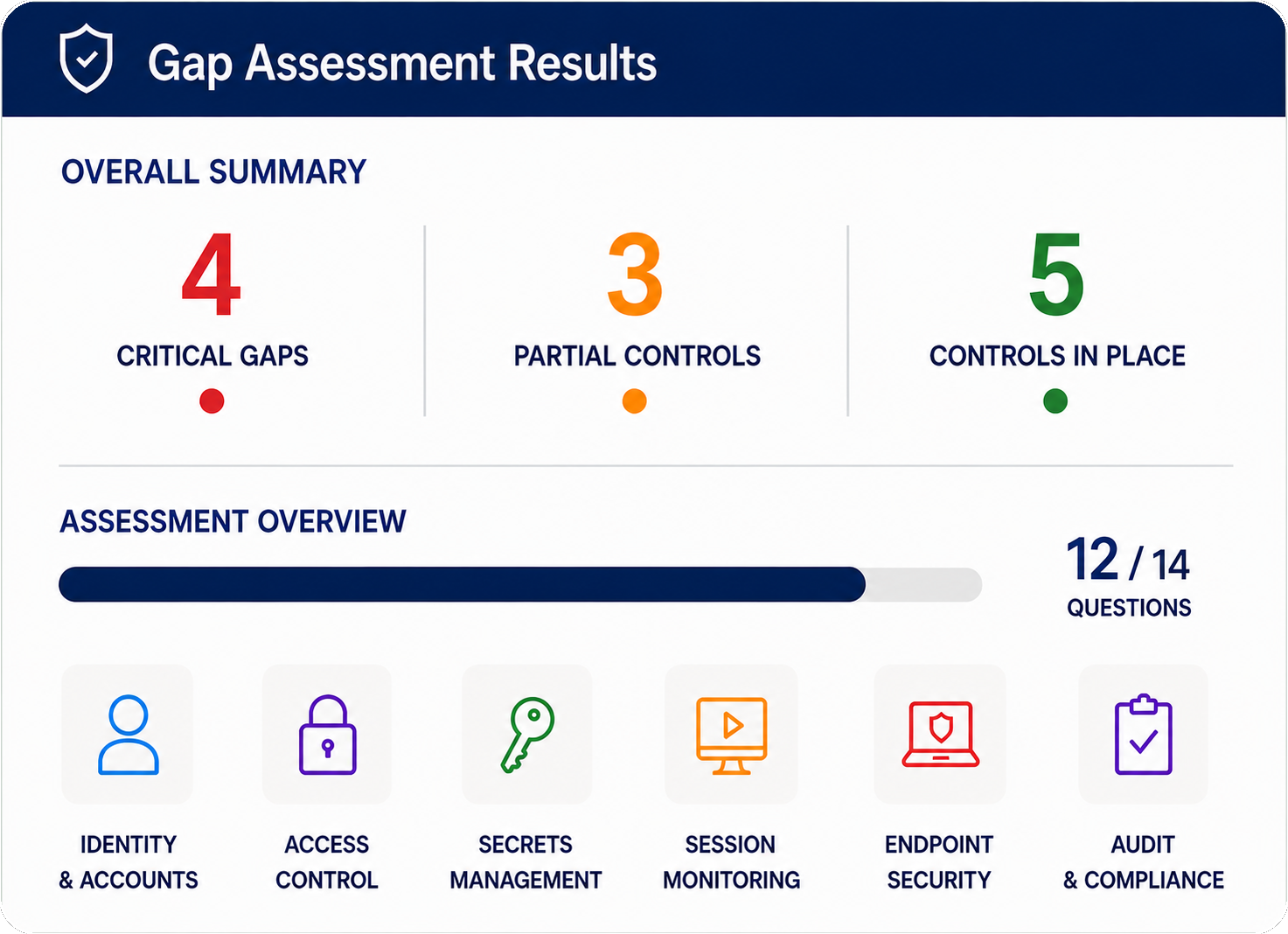
The accounts are there. The exposure is real. The only question is whether you know where it is before an attacker does. Take our Ransomware & Data Breach Gap Analysis below, a structured assessment that identifies the privileged access exposures in your environment most likely to be exploited, and shows you exactly how much risk you are carrying right now.
How Exposed Is
Your Company?
Uncover hidden risks across privileged accounts, credentials, vendor access, MFA, session monitoring, and compliance controls. Take our 5 minute Gap Assessment to see where your biggest security gaps may be hiding.